
How Coconut Water Producers Seal PET Bottles with an Automatic Screw Capping Machine
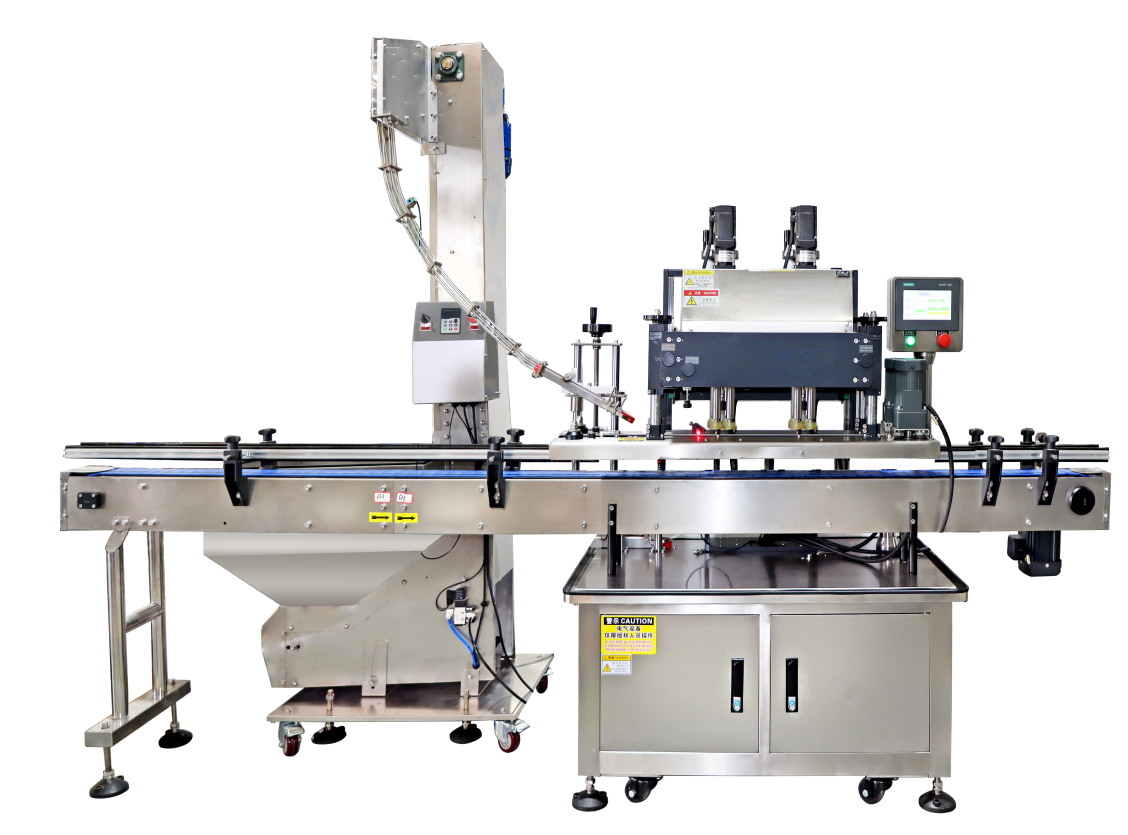
Coconut water producers commonly use PET bottles with threaded plastic caps because this packaging format is lightweight, practical, and suitable for automated beverage production. After coconut water is filled into the PET bottle, the threaded cap must be correctly positioned and tightened to create a reliable closure. An automatic screw capping machine performs this process by feeding caps, positioning bottles, and rotating the caps onto the bottle neck with controlled tightening force.
How Does a 4 Wheel Screw Capping Machine Seal Coconut Water PET Bottles?
After coconut water is filled into PET bottles, bottles are conveyed toward the capping station while the automatic cap loading system continuously supplies threaded caps. The bottle positioning mechanism aligns each bottle before capping so that the cap is placed correctly on the bottle neck. The four-wheel capping system then applies balanced tightening force around the cap while rotating it onto the bottle thread.
The four-wheel high-speed capping system is particularly important for continuous production because the cap is tightened from multiple contact points rather than relying on a single tightening point. Adjustable capping torque allows the operator to select a suitable tightening force according to the cap material, bottle neck design, and required closure performance. Correct torque helps reduce the risk of loose caps while avoiding unnecessary stress on the cap or bottle neck.
The Double Head 4 Wheel Screw Capping Machine from Guangzhou Full Harvest Industries Co., Ltd. is designed for manufacturers requiring higher-output screw cap sealing. Its double-head configuration and independent speed regulation motors allow the capping process to operate continuously, while automatic bottle positioning and cap loading reduce manual handling. For coconut water producers, this configuration helps connect bottle filling and screw capping into a more continuous beverage packaging process.
What Machine Features Help Prevent Loose Caps on Coconut Water Bottles?
Loose caps can occur when a cap is not correctly positioned, the bottle is not properly aligned, or the tightening force is unsuitable for the closure system. The machine addresses these factors through automatic bottle positioning, adjustable capping torque control, four-wheel cap tightening, and automatic cap loading. Together, these functions help create a more repeatable screw capping process for PET bottles.
The machine's flexible bottle and cap compatibility allows it to handle different bottle shapes, container sizes, and threaded cap designs when the specifications are suitable for the machine. The four-wheel tightening structure applies balanced pressure around the cap, while independent speed regulation motors allow each capping head to be adjusted for stable operation. These features are useful when coconut water manufacturers need to run different bottle formats without replacing the complete capping system.
| Specification | Double Head 4 Wheel Screw Capping Machine |
|---|---|
| Capping Method | 4-Wheel Screw Capping |
| Capping Speed | 35–40 containers/min |
| Bottle Diameter | 35–130 mm |
| Bottle Height | 30–220 mm |
| Capping Heads | Double Head |
| Cap Type | Threaded Screw Caps |
| Cap Loading | Automatic |
| Torque Control | Adjustable |
| Bottle Positioning | Automatic |
| Motor Control | Independent Speed Regulation |
For a coconut water packaging line, the typical process can be organized as PET bottle preparation → coconut water filling → cap loading → bottle positioning → four-wheel screw capping → labeling → inspection → secondary packaging. The exact line configuration depends on the bottle, cap, product process, and required production capacity. Matching the cap thread, bottle neck, and tightening torque to the machine is essential for achieving reliable screw cap sealing.
Why Use Four Wheels Instead of a Single Capping Point?
A four-wheel screw capping system uses multiple contact points around the cap to perform the tightening operation. This arrangement helps distribute the gripping and tightening action around the closure, supporting smoother cap rotation and more consistent contact during high-speed production. It is particularly useful for manufacturers looking for stable screw capping at higher output rates.
The Double Head 4 Wheel Screw Capping Machine combines two capping heads with four-wheel tightening technology to support an output of approximately 35–40 containers per minute. Its automatic cap loading and bottle positioning systems reduce repetitive manual operations, while adjustable torque control allows the machine to be configured for different threaded cap requirements.
For coconut water producers, the main objective is not simply to increase capping speed. The bottle, cap, thread, and tightening force must work together as one closure system. By using controlled four-wheel tightening, accurate bottle positioning, and automatic cap supply, the machine provides a practical solution for maintaining consistent screw cap sealing during continuous PET bottle production.
How Should Coconut Water Producers Choose a Screw Capping Machine?
The most important factors include bottle diameter, bottle height, bottle neck and thread design, cap dimensions, required torque, production speed, and format changeover requirements. A machine should be selected according to the actual PET bottle and threaded cap rather than based on speed alone.
For manufacturers producing several coconut water bottle formats, flexible adjustment and automatic positioning can help simplify production changes. For higher-output applications, a double-head four-wheel configuration can provide greater capping efficiency. Guangzhou Full Harvest Industries Co., Ltd. provides packaging machinery solutions for food and beverage manufacturers seeking automatic cap loading, controlled screw tightening, flexible container handling, and continuous production performance.