
How Does an Automatic Vacuum Capping Machine Work?
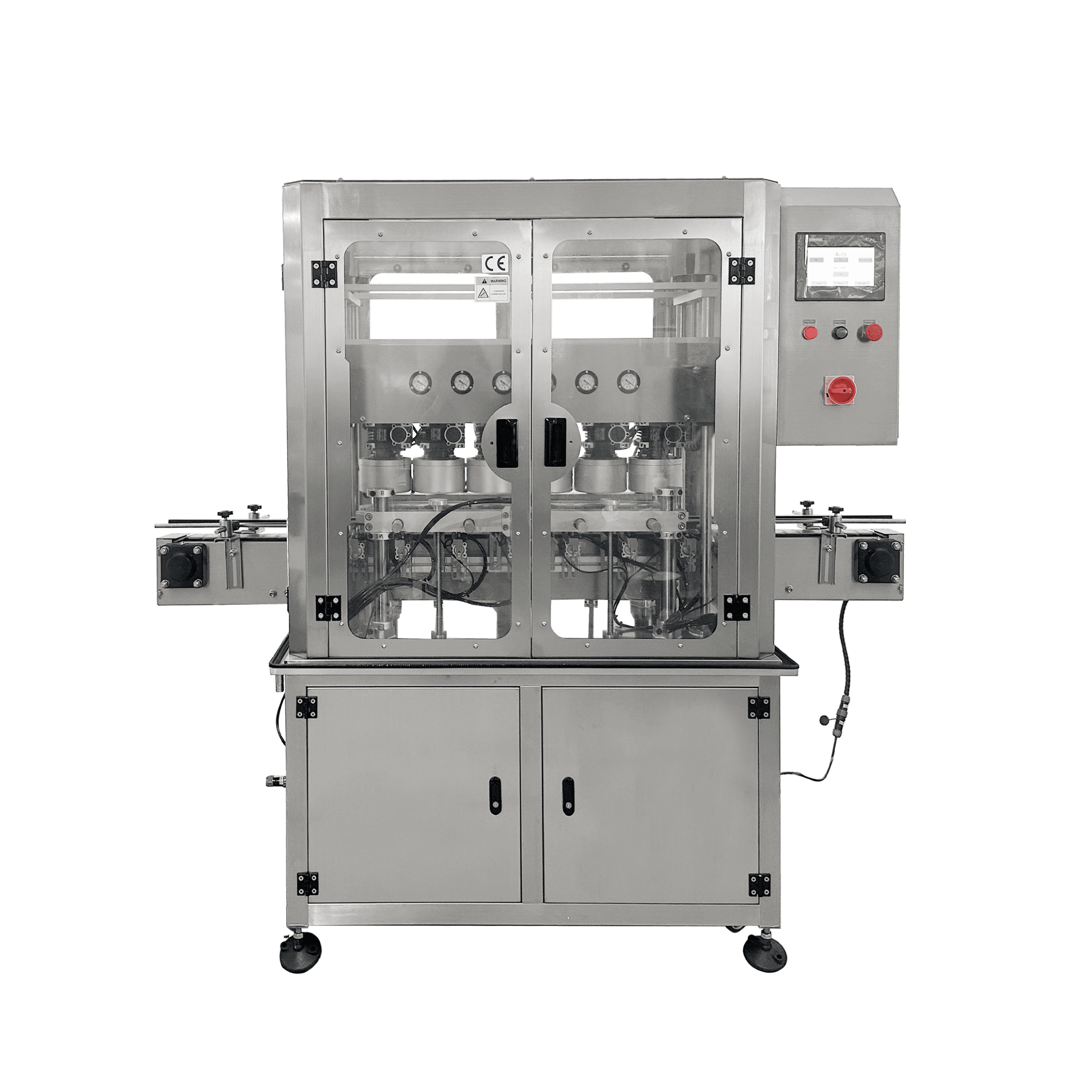
An automatic vacuum capping machine is a packaging machine designed to remove air from a jar and seal it with a twist-off lid. During the vacuum capping process, the machine positions the container, places the lid on the jar, creates a vacuum inside the container, and tightens the lid to form a secure closure. This process is widely used for glass jars containing food products that require reliable sealing and controlled vacuum conditions.
The Automatic High Speed Vacuum Capping Machine is designed for continuous vacuum sealing of glass jars and twist-off lids. With a six-head high-speed sealing system, the machine can achieve approximately 40–48 containers per minute, with a compatible container diameter range of 50–80 mm and container height range of 65–200 mm. The equipment is suitable for large-scale food packaging lines requiring continuous jar sealing and stable vacuum performance.
How Does an Automatic Vacuum Capping Machine Create a Vacuum?
The vacuum capping process starts when filled glass jars enter the capping station and are accurately positioned. The twist-off lid is supplied by the automatic cap lifting system and placed onto the jar. The machine then performs the vacuum extraction and cap tightening process according to the configured operating parameters.
During vacuum capping, air is removed from the headspace of the jar before or during the sealing operation, depending on the specific machine configuration and product process. Once the required vacuum condition is achieved, the twist-off lid is tightened onto the jar. Proper coordination between vacuum extraction and cap sealing is important because the lid must form a reliable closure while the desired vacuum is maintained.
The Automatic High Speed Vacuum Capping Machine integrates jar positioning, vacuum extraction, and cap sealing into an automatic production sequence. Its intelligent control system manages the main operating steps, reducing manual intervention and helping maintain repeatable sealing performance. For food manufacturers, this provides a more consistent alternative to manually applying and tightening twist-off lids.
Why Is Vacuum Important for Twist-Off Jar Sealing?
Vacuum sealing is important for products where reducing the amount of air inside the container is part of the packaging process. A properly sealed twist-off lid helps create a closed package and can support the required packaging conditions for many food products. The actual vacuum requirement depends on the product, jar, lid, filling temperature, and processing method.
For this reason, vacuum capping should not be evaluated only by capping speed. Manufacturers should also consider the jar diameter, jar height, lid specification, required vacuum level, product characteristics, and production capacity when selecting a vacuum capper. Correct matching between the jar, lid, and machine configuration is essential for stable vacuum sealing.
Why Use a Six-Head High-Speed Vacuum Capper?
A six-head vacuum capping system allows multiple jars to be processed within the capping cycle, making it suitable for higher-output food packaging lines. Instead of relying on a single sealing head, the six-head configuration increases the number of containers that can be handled during continuous production. The Automatic High Speed Vacuum Capping Machine is rated at approximately 40–48 containers per minute, depending on the actual application and production conditions.
The machine also includes a smooth automatic cap lifting system that continuously supplies twist-off lids to the sealing station. This reduces manual lid handling and helps maintain an organized supply of caps during high-volume operation. The capping heads can be configured according to different jar diameters, lid types, and production requirements, providing greater flexibility when packaging formats change.
Guangzhou Full Harvest Industries Co., Ltd. is a packaging machinery manufacturer providing equipment for food and industrial packaging applications. Its vacuum capping solutions are designed for manufacturers requiring automated jar positioning, vacuum extraction, twist-off lid sealing, and continuous production. For large-scale food processing operations, the company's automatic vacuum capping equipment can be configured according to the customer's container, lid, and production requirements.
| Specification | Automatic High Speed Vacuum Capping Machine |
|---|---|
| Capping Type | Automatic Vacuum Capping |
| Lid Type | Twist-Off Lid |
| Capping Speed | 40–48 containers/min |
| Container Diameter | 50–80 mm |
| Container Height | 65–200 mm |
| Capping Heads | Six Head |
| Container Type | Glass Jars and Containers |
| Cap Supply | Automatic Cap Lifting |
| Operation | Automatic |
| Application | High-Speed Food Packaging |
What Types of Jars Can an Automatic Vacuum Capper Handle?
An automatic vacuum capper is primarily used for glass jars and containers with compatible twist-off lids. The machine can accommodate different jar shapes and sizes within its configured operating range. For the Automatic High Speed Vacuum Capping Machine, the stated container diameter range is 50–80 mm, while the container height range is 65–200 mm.
Different jar shapes can require different positioning and capping configurations. Wide-mouth jars, narrow jars, tall jars, and short containers may have different center positions and lid specifications. The capping head configuration should therefore be matched to the actual jar and twist-off lid before production.
What Factors Should Be Checked Before Choosing a Vacuum Capping Machine?
Food manufacturers should provide the jar diameter, jar height, lid diameter, lid type, product characteristics, required vacuum conditions, and target production speed when selecting an automatic vacuum capper. These specifications determine how the vacuum system, cap lifting mechanism, positioning structure, and capping heads should be configured.
For high-volume production, manufacturers should also consider the number of capping heads and the required operating speed. The six-head configuration of this machine is designed for approximately 40–48 containers per minute, while its automatic cap lifting, multi-shape container adaptability, intelligent operation, and flexible capping head configuration support continuous twist-off jar sealing.
A typical food packaging process can be arranged as product filling → jar preparation → twist-off lid loading → vacuum extraction → cap tightening → sealing inspection → labeling → secondary packaging. Integrating the vacuum capper with upstream and downstream equipment can help create a continuous packaging line while reducing manual handling between processes.