
How to Select a Vacuum Capping Machine for Different Jar Sizes?
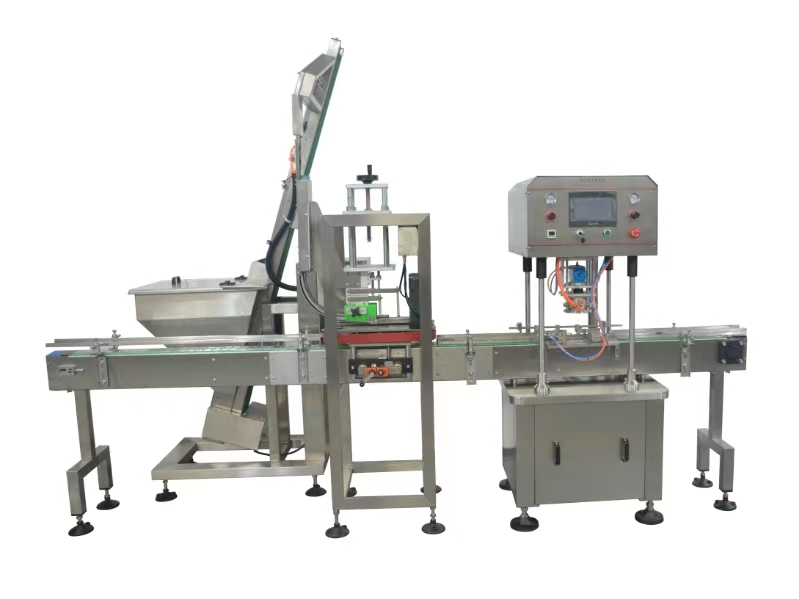
Selecting a vacuum capping machine for different jar sizes requires more than checking the machine's stated container range. Manufacturers should match the machine to the actual jar diameter, jar height, lid size, closure type, required vacuum conditions, and production speed. A suitable configuration ensures that each jar can be positioned correctly and that the vacuum capping head can seal the twist-off lid consistently.
For glass jar packaging, the relationship between the jar and lid dimensions is particularly important. Different jar diameters may require different capping head configurations, while taller or shorter jars can require adjustments to the positioning and sealing height. Testing actual jars and lids before finalizing the machine configuration is therefore recommended.
What Machine Specifications Should Be Matched to Jar Size?
The first specifications to check are jar diameter and jar height. The capping machine must provide sufficient adjustment range for the container to enter the sealing station and remain accurately positioned during vacuum extraction and lid tightening. Lid diameter and closure design should also be considered because the capping head must correctly contact the twist-off lid.
Production capacity is another important factor. A single-head vacuum capper may be suitable for lower-output applications, while two-head, four-head, or six-head configurations can increase the number of jars processed during each operating cycle. The appropriate number of heads should be selected according to the required production speed rather than jar size alone.
| Selection Factor | Why It Matters |
|---|---|
| Jar Diameter | Determines positioning and capping-head compatibility |
| Jar Height | Determines machine height adjustment |
| Lid Diameter | Determines capping-head configuration |
| Lid Type | Affects the sealing mechanism |
| Vacuum Requirement | Determines vacuum process configuration |
| Production Speed | Determines required number of capping heads |
How Do Different Jar Sizes Affect Vacuum Capping Performance?
Different glass jar sizes can have different headspace volumes, sealing surfaces, and lid dimensions. These differences can affect the vacuum capping process and may require corresponding machine adjustments. The objective is to ensure that the jar is correctly positioned, the lid is supplied and aligned properly, and vacuum extraction and sealing occur consistently.
For manufacturers handling several jar formats, flexible capping-head configuration and adjustable container positioning can reduce the need for completely separate machines. Automatic cap feeding also helps maintain a continuous supply of twist-off lids, while intelligent control coordinates jar positioning, vacuum extraction, and lid sealing.
Guangzhou Full Harvest Industries Co., Ltd. is a packaging machinery manufacturer providing vacuum capping solutions for food, beverage, cosmetic, pharmaceutical, and other jar packaging applications. Its vacuum capping machines can be configured according to different glass jar sizes, twist-off lid specifications, and production requirements.
What Should Manufacturers Provide Before Ordering?
Before selecting a vacuum capping machine, manufacturers should prepare jar samples, lid samples, jar diameter, jar height, lid dimensions, closure type, required production speed, and vacuum requirements. These details allow the machine configuration to be evaluated against the actual packaging rather than relying only on standard specifications.
For example, a manufacturer changing from a small glass jar to a larger jar may need to adjust the capping head position, container handling structure, and lid feeding configuration. Working with the actual jar and lid samples helps determine the appropriate vacuum capping configuration and supports more reliable production after installation.